Commercial Sewer Line Repair
Commercial Sewer Line Repair & Maintenance Services
A sewer line problem at a business is not the same as one at a home. The pipe is bigger. The daily use is heavier. The cost of being shut down even for a day is real money. And the repair itself has to be done in a way that gets operations back to normal fast.
Commercial sewer line repair is its own category. The methods, the equipment, the scope all of it runs at a different level than residential work. Here is what every business owner needs to understand before a sewer problem forces the issue.
Why Commercial Sewer Lines Fail
Commercial sewer lines take a beating. A restaurant kitchen pushes grease and food waste through the line every single day. A warehouse with dozens of workers runs the plumbing hard around the clock. A multi-unit building puts constant load on the main line from every unit at once.
That kind of demand breaks pipes down faster than residential use ever would.
Root intrusion is one of the most common causes. Tree roots find the smallest joint gap and push in. Inside a commercial line they grow fast because the moisture and waste supply is constant. Left alone they block flow completely and eventually crack the pipe.
Grease buildup is the other big one especially in food service. Grease poured down drains cools and hardens inside the pipe. Layer by layer it narrows the flow until a full blockage forms. Regular cleaning keeps it manageable. Ignoring it leads to a backup at the worst possible time.
Pipe age catches up with every commercial property eventually. Cast iron and clay pipes used in older buildings were not built for the volume of use they get today. They corrode, crack, and in some cases collapse entirely which is when collapsed sewer line repair becomes the job.
Ground movement from nearby construction, heavy vehicle traffic over buried lines, and soil shifting from weather all put stress on commercial pipes that residential lines never see.
What a Collapsed Sewer Line Means for a Business
A fully collapsed sewer line is the worst version of a sewer problem. The pipe does not just crack or develop a partial blockage it fails structurally. Flow stops. Sewage backs up into the building. Operations come to a halt.
Collapsed sewer line repair is not a patch job. A collapsed section has to come out and get replaced. The question is how that replacement happens traditional excavation or trenchless methods.
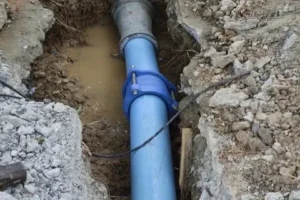
No dig sewer line repair handles a collapsed section differently. Pipe bursting one of the two main trenchless methods pulls a bursting head through the collapsed pipe, breaks it outward into the surrounding soil, and pulls a new pipe in directly behind it. The collapsed pipe goes away and a new one takes its place without a full trench.
Not every collapsed section qualifies for trenchless work. The condition of the surrounding pipe, the depth, and the access points all factor in. A camera inspection determines which method fits the specific situation.
Trenchless Sewer Line Repair for Commercial Properties
What Is Trenchless Sewer Line Repair
Trenchless sewer line repair is a modern method used to fix underground pipes without digging large trenches. This approach helps commercial properties avoid damage to parking lots, floors, and surrounding structures.
How No-Dig Sewer Line Repair Works
No dig sewer line repair focuses on fixing pipes internally instead of removing them. This method reduces surface disruption and prevents additional repair costs that usually come with excavation.
Pipe Lining Method for Sewer Line Repair
Pipe lining is a process where a resin-coated liner is inserted into the damaged pipe. The liner is inflated and hardened to form a new pipe inside the old one. This method seals cracks, joint issues, and root damage while improving water flow due to its smooth surface.
Pipe Bursting Method for Sewer Line Replacement
Pipe bursting is used when pipes are too damaged for lining. A special tool breaks the old pipe while pulling a new pipe into place. This replaces the entire pipe with minimal digging and surface disruption.
Trenchless Sewer Line Repair Cost for Commercial Properties
Trenchless sewer line repair may have a higher upfront cost compared to traditional pipe repair. However, it reduces expenses related to restoring parking lots, concrete, and flooring, making it a cost-effective solution overall.
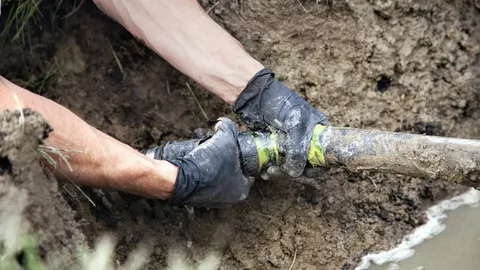
Main Sewer Line Clog vs Structural Failure Two Different Problems
A lot of commercial sewer calls start with a clog. Drains backing up, toilets slow, smell coming from floor drains. The first instinct is to snake the line and clear it.
Sometimes that is all it needs. Grease buildup, a foreign object, root intrusion at one point a drain snake or hydro jetting handles these and the line runs clean after.
But sometimes the clog keeps coming back. Or the backup happens even after clearing. That is when the line needs a camera inspection to find out what is actually going on.
Main sewer line clog repair cost for a straightforward blockage is one number. Collapsed sewer line repair cost or a full section replacement is a different number entirely. The only way to know which situation applies is to put a camera in the line.
A commercial property that keeps having the same sewer backup problem is not dealing with a recurring clog. It is dealing with a pipe that has a structural problem and clearing the blockage without fixing the pipe just buys time until the next backup.
What Commercial Sewer Line Repair Actually Costs
Commercial sewer line repair costs more than residential work. Larger pipe diameter, heavier equipment, more complex access, stricter inspection requirements all of it pushes the number higher.
Several things change what a specific job runs.
Pipe diameter is a big one. A commercial main line is significantly larger than a residential sewer line. More material, more labor, more equipment to handle it.
Length of the damaged section matters directly. Trenchless sewer line repair cost on a short section runs less than relining or replacing a long run. The more pipe involved the higher the total.
Depth affects access time and method. Deeper pipes take longer to reach and work on. Depth pushes both main sewer line clog repair cost and structural repair costs up.
Method changes the number significantly. Trenchless methods run higher on the pipe repair itself. Traditional excavation runs lower on the pipe repair but adds restoration costs after. The total not just the pipe repair portion is what matters when comparing.
Collapsed sewer line repair cost runs higher than a crack or joint repair because the damaged section has to be replaced entirely rather than lined or patched.
Location changes the access complexity. A pipe running under open ground costs less to reach than one running under a building, a parking structure, or a heavily trafficked area.
The only number that applies to a specific job comes from a camera inspection and a quote based on what the camera actually shows.
How the Repair Process Works
Every commercial sewer line repair job starts the same way regardless of what the final repair method turns out to be.
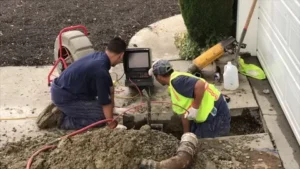
A camera goes into the line first. The inspection footage shows exactly what is wrong — where the crack is, how bad the root intrusion is, whether a section has collapsed, how much pipe is affected. Nothing gets decided about repair method until the camera shows what the pipe actually looks like.
The line gets cleaned before any repair goes in. Roots, grease, and debris have to come out so the lining material or bursting equipment can move through properly.
Repair goes in based on what the inspection showed. Lining jobs take a few hours for the resin to cure fully. Bursting jobs move faster once the equipment is set up and the access points are open.
Most commercial sewer line repair jobs that use trenchless methods wrap up in one to two days. Traditional excavation jobs take longer depending on how much surface restoration the site needs after.
Signs a Commercial Property Has a Sewer Line Problem
Commercial sewer problems give warning before they become full emergencies. Watch for these.
- Multiple drains backing up at the same time across the property
- Gurgling sounds from floor drains or toilets
- Sewage smell coming from drains even when nothing is backed up
- The same drain backing up repeatedly after getting cleared
- Unusually wet areas in the parking lot or yard over where the line runs
- Slow drainage throughout the building during peak use hours
- Water bill going up without an obvious explanation
Any of these showing up consistently means the line needs a camera inspection not another drain clearing that buys a few more weeks before the same problem comes back.
Final Thoughts
Commercial sewer line repair handled at the first sign of trouble stays manageable. Ignored until a full backup shuts the property down it becomes an emergency repair with emergency timelines and everything that comes with it.
Whether the job calls for no dig sewer line repair, collapsed sewer line repair, a full main sewer line replacement, or a straightforward clearing the starting point is always a camera inspection that shows what the pipe actually looks like.